
Cleaning advice · 16 Oct 2026
Can stained old tiles in Ipoh be restored without re-tiling?
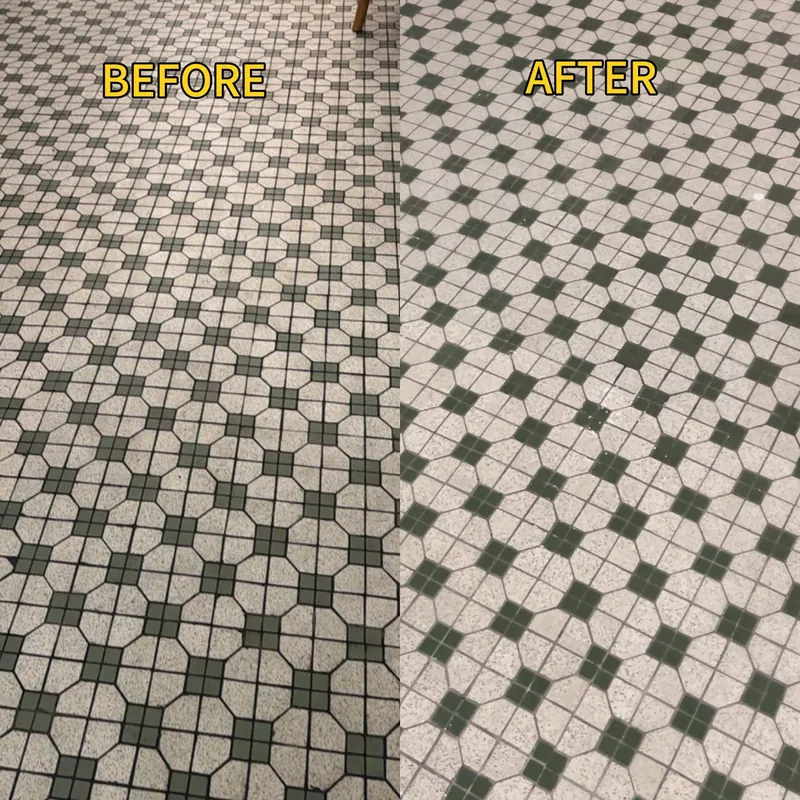
Often, yes. Where the tiles are sound and firmly bedded, what looks like a ruined floor is usually soil worked into the surface and grout gone dark rather than damage, and a clean reaches both. Replacement is the answer when the tile has worn through or rows have lifted. Water still getting in is a leak to fix before anything is decided.
On this page8 sections
01Can old tiles be restored instead of replaced?
Stained old tiles can usually be restored without re-tiling, as long as the tiles are sound and still firmly bedded. This page is the decision-stage companion to our tile, floor and grout restoration guide, which covers how the work itself is done.
Five checks settle it in about ten minutes, and a reader can make all of them without equipment.
- Look along the floor in low, raking light. Dullness spread evenly over the whole floor is usually soil. Dullness only in the walkways is wear.
- Wet a patch with plain water. Dullness that goes while the floor is wet and returns as it dries points to a film sitting on the surface rather than worn tile.
- Look closely at the tile face for fine cracks across the glaze with dirt sitting in them. Preservation Brief 40 is blunt about those: "dirt entering these cracks cannot be removed".
- Tap across the floor, not in one place. What matters is whether some areas sound different from the rest — see the hollow-tile question below.
- Look for a damp source above or behind the worst area: a shower wall, a planter, a leaking pipe. Water changes the answer more than anything else on this list.
Send daylight photographs to 014-313 0767, with the age of the floor, and you get a first read on which of the three it looks like. A site visit decides the quote.
02Is it soil, the grout, or damage to the tile itself?
Soil comes off; a stain has gone into the material and may or may not; damage is a change to the surface itself, which cleaning does not reverse. Preservation Brief 40 — the United States National Park Service's guidance on historic ceramic tile floors, by Anne E. Grimmer and Kimberly A. Konrad — is honest about the limit: cleaning a tile floor is "relatively easy" in most cases, but "heavily soiled areas may be difficult or impossible to clean completely".
| What you are looking at | What the brief says | Which job it is |
|---|---|---|
| Soil worked into the surface, grease, traffic marks | Cleaning "should always begin with the gentlest means possible" | Cleaning. Expect a result, not perfection |
| Grout gone dark while the tiles look sound | "Even glazed tiles are somewhat porous, and can get dirty and stained" — and a joint is more absorbent again | Cleaning, and it is where most of the visible change comes from |
| Joints crumbling, missing or soft | "Deteriorated mortar joints and loose mortar or grout can generally be repaired" | Re-grouting: a tiler, not us |
| Fine cracks across the glaze with dirt in them | Crazing is "not generally a serious material failure" unless it "visibly extends into the porous clay of the tile body beneath" — but "dirt entering these cracks cannot be removed" | Cannot be cleaned out. Live with it |
| Pattern worn away, hollows at doorways | Patterned encaustic and geometric tiles are "extremely susceptible to abrasion"; traffic causes "uneven wear, or even cupping" | Replacement, if the look matters. Cleaning changes nothing |
| Tiles that rock, lift or sound different when tapped | Loose tiles are "often the result of weakened or deteriorated grout or mortar" | A tiler, not a cleaner |
A mark that survives a correctly chosen clean is evidence about the floor, not about the cleaner. One exception matters: on marble and other stone a dulled or lightly etched surface is not a cleaning problem, but not necessarily a replacement one either, because polishing reworks the surface where cleaning cannot — see scrubbing versus polishing. Residue on a newly tiled floor is a different problem again: cement, grout haze and paint on new tiles.
03Why does a clean floor still look old?
Dark grout is the usual reason a floor that has just been cleaned still looks old. The joints are softer and more absorbent than the tile beside them, so a bathroom can end up with sound tiles framed in lines that look black.
Dark grout is two different problems, and only one of them is cleaning. Joints that are intact but soiled are cleaning work, and that is where a restoration gets most of its visible result. Joints that have broken down are repair work, and Preservation Brief 40 is encouraging about it: "deteriorated mortar joints and loose mortar or grout can generally be repaired", the damaged mortar taken out by hand and the joints regrouted. Cutting joints out and refilling them is re-grouting, which Kean Can Cleaning Service does not do — that belongs to a tiler, with re-tiling and replacing cracked tiles.
Expect colour to be approximate either way: the brief asks for grout matching the old "in color and consistency as closely as possible", and a joint that was white when laid may not go back to white. Do not force it with stronger chemistry — mortar "may also be weakened or loosened by cleaning solutions that are too strong".
04When should old tiles be replaced rather than restored?
Two conditions put an old floor beyond cleaning: the surface of the tile has worn through, so there is nothing left to clean back to, or rows of tiles have lifted away from their bed. No cleaning method reaches either. A third situation — water still getting into the floor — is not a decision at all until the water is stopped.
- The surface of the tile is gone. A pattern worn off or a glaze worn through is loss of the tile, not soil on it. Preservation Brief 40 shows the extreme version: floors in use for over a century, their patterns faint and worn away entirely in the busiest places.
- Rows of tiles have lifted. Where tiles pop up to relieve tension and separate from their bed, the brief says the condition "will probably require taking up and relaying many or all of the tiles" — a tiling job whether the original tiles go back down or new ones do.
Water is the case where doing anything to the tiles is premature. It is named in the brief as one of the most common causes of tile floor failure, and water sitting around showers and baths "can eventually damage grout and mortar, and loosen tiles". Stopping it is a plumbing or waterproofing job rather than a cleaning or tiling one, and the brief fixes the order plainly: "If damage to tiles is the result of more than normal wear and tear, the source of the problem needs to be identified, and the problem corrected before replacing the damaged tiles." The same trap is set out in mould after a leak.
One caveat belongs on this page: Kean Can Cleaning Service cleans and restores floors, and does not re-tile, replace cracked tiles or re-grout. Both cases above are a tiler's work, and saying so early saves a wasted visit.
05Why does replacing a few tiles rarely look right?
Replacing a few tiles disappoints for two reasons: the new tile has to match a floor decades older than it is, and getting the bad one out puts its neighbours at risk. On matching, Preservation Brief 40 is blunt about "the difficulty of matching new and old tiles which are slightly different in color, pattern and thickness".
Removal is the other half of the problem: "Trying to remove one tile can endanger surrounding tiles." The brief explains why attempts fail — "the shock of the blows to the tile being removed travels through the grout into surrounding tiles and cracks them" — and says all the grout around it must come out first, by an experienced tile installer. It adds the condition people forget: "Successful replacement not only depends on the availability of matching tiles, but on the condition of the substrate on which the tiles are laid."
So a rip-out is more than lifting tiles: the joints come out first, the bed underneath is inspected and sometimes made good, and whole sections get re-laid rather than single tiles swapped, because a patch of matched-but-not-identical tile reads as a repair. None of that makes partial replacement wrong. Where a floor genuinely cannot be restored, replacing the affected area is usually cheaper than repeated attempts at cleaning it; the trade-off is the match and the risk to its neighbours.
06How do you find out which one your floor needs?
A floor tells you which job it needs through a test patch, and Preservation Brief 40 asks for exactly that: "All cleaning and stain-removal products should always be tested on a small, inconspicuous area before using." On our jobs that patch is the cleaning team's, in a corner, before anything is done at scale — never the homeowner's. We also ask what the floor is made of when quoting, because the right method depends on it.
That question matters in Ipoh, where older properties often have patterned mosaic or terracotta. The colour is usually still there under the soil, which is what makes those floors worth restoring; but they are porous and often bedded on lime rather than modern adhesive, so they are treated slowly, with neutral chemistry and softer pads. A glazed or homogeneous tile in a newer house is harder and far less absorbent, and the historic-floor cautions above do not all apply to it.
Protecting the result afterwards is a smaller decision than it is usually sold as. The brief notes that impregnators "can reduce the porosity or water absorption of the tile surface, and provide some protection for the tile (and the grout) against staining": useful on a porous floor, close to pointless on a glazed one.
Floor work is quoted only after a site visit, not from photographs. Photographs get you a first read; they cannot price a floor whose material, bedding and soil nobody has stood on. Kean Can Cleaning Service has been cleaning in Ipoh and Perak since 2019, and tile and floor restoration is one of its service lines. Send photographs to 014-313 0767 with the age of the floor and the rooms affected.
07What else do people ask about restoring old tiles?
The tiles sound hollow when I tap them. Are they coming off?
Not necessarily — what matters is whether the sound changes across the floor. Donato Pompo of Ceramic Tile and Stone Consultants writes in TileLetter that "if an entire tile installation sounds hollow it may be a result of the type of substrate that was used and not an indication of a problem", while "what signals debonding is a differential in sound from one area of an installation to another". His own example: on a floor where 75 per cent of tiles sound solid and 25 per cent sound hollow, "this can raise a red flag".
A tile is chipped or cracked. Does it have to be replaced?
Often not: Preservation Brief 40 prefers repair. "Sometimes cracks may be repaired, or a corner or piece of tile that has broken off may be reattached, using an epoxy glue, or grout", and on a chip a carefully executed patch of tinted epoxy or mortar "may be less conspicuous than trying to replace every tile that has even the slightest damage". Tile repair is a tiler's work, not ours.
Can an old patterned floor be machine-scrubbed?
Not until someone has established what the floor is made of. On historic floors Preservation Brief 40 is firm that abrasive cleaners and "mechanical equipment can damage and wear away the protective surface, as well as the decorative design on the tiles, and should not be used on ceramic tile floors". Our own practice follows from that: a heritage mosaic or terracotta floor gets neutral chemistry, softer pads and considerably more time, after a test patch, while a hard modern tile tolerates machine work the patterned floor would not survive.
08Where this comes from
Published 16 October 2026. Last updated 16 October 2026. Sources read 16 October 2026.
- Preservation Brief 40: Preserving Historic Ceramic Tile Floors, Anne E. Grimmer and Kimberly A. Konrad, Technical Preservation Services, United States National Park Service — every quotation above attributed to the brief.
- Hollow-sounding tiles may signal installation problems, Donato Pompo, Ceramic Tile and Stone Consultants, in TileLetter, 29 July 2013 — what a hollow tone does and does not prove, and the 75 per cent example.
Preservation Brief 40 is written for historic ceramic tile floors in the United States. This page quotes and summarises it rather than reproducing it, and it is neither a Malaysian standard nor a survey of your floor: a hard modern porcelain tile does not behave like a nineteenth-century patterned one, which is why what the floor is made of is settled before any method is chosen. The service list, the service area, the test-patch practice and the site-visit rule are Kean Can Cleaning Service's own.
Ask about your property
Send a photograph and tell us the scope so the team can assess the work.
Ipoh and across Perak.