
Cleaning advice · 03 Oct 2026
Floor scrubbing vs polishing - which does your dull floor need?
Scrubbing takes off what is sitting on a floor. Polishing works on the surface itself. The question is whether the floor is dirty or worn, and polishing a floor that has not been cleaned first makes it worse: Nilfisk's guidance is to avoid burnishing a dirty floor because dirt can get trapped under the polish. Which one your floor needs is settled by a test patch, and that patch is the cleaning team's.
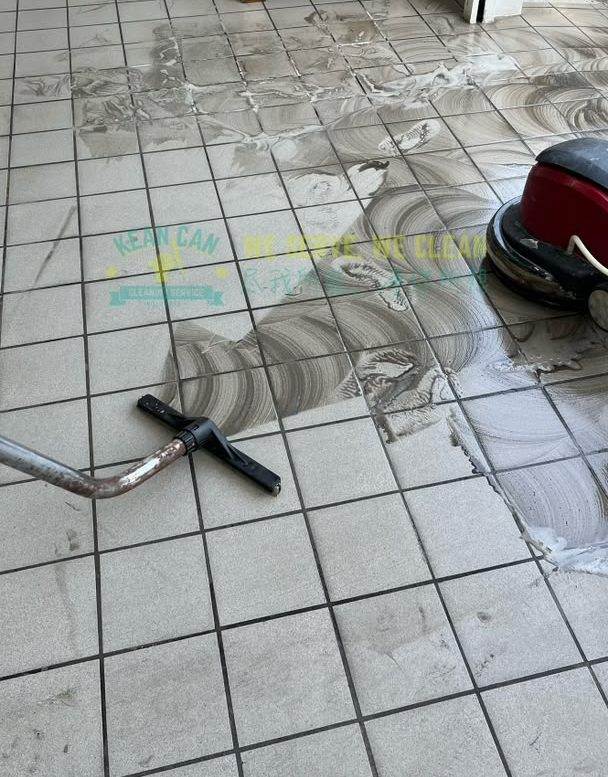
01What is the difference between floor scrubbing and floor polishing?
Scrubbing removes soil from a floor. Polishing changes how the floor's surface reflects light. Scrubbing is a cleaning operation, working dirt loose with water, a cleaning agent and a brush or pad. Polishing is a finishing operation, worked over a surface that is already clean, to bring up a shine.
The machines the trade uses make the split obvious. Nilfisk, which builds both, puts it as a difference of purpose: "a burnisher focuses on polishing for shine, whereas a buffer provides a wider range of cleaning and maintenance functions." The speeds differ with the purpose. Nilfisk gives buffers 150 to 330 revolutions per minute, and burnishers 1,000 to 3,000.
That is why one machine cleans and the other does not. A slower machine works dirt off the surface; a much faster one passes lightly over a surface to bring up gloss. Tennant says that "most of the burnisher's work happens lightly on the top layer of floor finish", and notes that while burnishing is a high-speed process, it is not a high-pressure one.
The same split, written from the floor's side rather than the machine's, is on the restoration guide.
02Why does my floor look dull: is it dirty or worn?
A dirty floor is dull because something is lying on it. A worn floor is dull because the surface itself has been changed. Telling the two apart needs a test patch done by whoever is going to do the work, and a homeowner should not reach for a product and a pad, because the wrong one marks some floors permanently. What you can do is look carefully and describe what you see.
Three observations are worth making before you send an enquiry. Look at the floor in low, raking light, across it rather than down at it. Note whether the dullness is even across the whole floor or concentrated in the walkways. And wet a patch with plain water: if the dullness disappears while the floor is wet and comes back as it dries, that is the signature of a film on the surface rather than a worn surface, as the restoration guide sets out.
What is lying on it may be a film left by building work, grease carried out of a kitchen, or traffic soil ground into a textured surface. Nothing has happened to the floor itself, so scrubbing is both the cheaper answer and the complete one.
Where the surface itself has been changed, no amount of extra scrubbing fixes it. A cleaner who keeps scrubbing a worn floor is charging for an outcome the method cannot produce. Which of the two you have is what the test patch establishes, and it is a ten-minute step before any work at scale.
Post-renovation floors are the common mixed case. They are usually dirty rather than worn, under a mineral film from the wet trades, and what is actually stuck to them is set out in how to remove cement, grout haze and paint from new tiles. Scratching caused during the build is the part that no clean will lift.
03Why polishing a dirty floor makes it worse
Polishing a dirty floor drives the dirt into the finish instead of taking it off. Nilfisk states the consequence plainly: "Avoid burnishing a dirty floor as that can cause dirt to get trapped under the polish." The gloss goes on over the soil, so the floor looks better briefly and is harder to put right afterwards.
The manufacturers' own sequence puts cleaning first, every time. Tennant's instruction is that "you always want to dust mop and wet mop a floor, at a minimum, before using a burnisher", and that "most often, you'll also want to buff the floor to work out deep scratches, scuffs, and stains before turning to the burnisher". Nilfisk is less absolute about it: it says that "in many cases, it is wise to use a buffer to clean a floor" or to remove the previous polish before repolishing.
Clean the floor, then decide whether it needs anything else. A quotation that goes straight to polishing on a floor nobody has cleaned yet has skipped the step both machine makers put first.
04Will your floor take a polish at all?
Not every floor will, and that is worth establishing before paying for one. Polishing assumes a surface that can be refined or a coating that can be brought up. Where a floor has neither, the honest answer is that it can be cleaned thoroughly, but not made glossier than the material allows, and a test patch is what settles it.
Kean Can lists marble and tile floor scrubbing and polishing as one service, so those are the floors where both halves of the job are on offer. The limits of what cleaning can and cannot reverse on a tile or stone floor are set out in the tile and floor restoration guide, which is the page to read before deciding a dull floor needs polishing.
Large industrial and commercial floors are usually the other case. Kean Can lists factory and warehouse floor scrubbing as its own service, without polishing attached, and on a working floor that is normally the right specification: the goal is soil removed and a safe, even surface, not a shine. Car-showroom polish and upkeep is listed separately again, because a showroom floor is judged under display lighting rather than on how clean it is.
If nobody can tell you which case your floor is, ask for it to be looked at rather than quoted blind. For floor work that visit is the rule and not the exception.
05Should I scrub or polish my floor?
Match the symptom to the service rather than to the word that sounds more thorough. The table below sets out the usual cases in the order they come up, and the last column is what to put in the enquiry so a cleaner can price the real job.
| What you are seeing | Most likely cause | What to ask for |
|---|---|---|
| Dull everywhere, dullness lifts while the floor is wet | Soil or product residue on the surface | A scrub and rinse, no polishing |
| Dull everywhere, and scratching visible in raking light | The surface itself may be worn | Cleaning, with a test patch before any polishing is quoted |
| Hazy film on a newly renovated floor | Cement film or grout haze from the wet trades | Post-renovation cleaning, with the residue named |
| Grey or greasy in traffic lanes only | Traffic soil worked into the surface | Machine scrubbing of those areas |
| Working floor, safety and soil are the concern | Normal industrial soiling | Factory or warehouse floor scrubbing |
What the tile and floor service covers, and how a floor is identified before it is touched, is on tile and floor cleaning and polishing, and the commercial equivalent is on commercial cleaning in Ipoh.
06What should you tell a cleaner when you ask for a quote?
Floor work is quoted after a site visit, not from a description alone. Five things still decide how quickly that visit turns into a price: the material, the area, what the dullness looks like, what has been used on it, and what the floor does when it is wet. The last is the most useful and the one almost nobody includes.
- What the floor is: marble or other stone, glazed or unglazed tile, cement, vinyl, or coated concrete. Say if you are unsure rather than guessing.
- Roughly how much of it there is, and which rooms or areas are affected.
- What the dullness looks like: even across the floor, worse in walkways, patchy, or a film you can feel.
- What has been used on it, including any product applied after the floor was laid, and whether it has ever been polished or coated before.
- What happens when you wet a patch with plain water: whether the dullness lifts while it is wet and returns as it dries.
Scope, timing and a price range follow the visit. The cleaning equipment and chemicals used are the company's own, as its frequently asked questions set out, so they are inside the quote rather than an extra.
07Questions people ask about scrubbing and polishing
Five questions come up again and again once the difference between scrubbing and polishing is clear. Each answer below is the short version, and the sections above carry the reasoning behind it. Where an answer depends on what your particular floor is made of, it says so rather than guessing, because that is what a test patch is for.
Will scrubbing alone make my floor shiny again?
It will if the shine was hidden under soil, and it will not if the surface itself is worn. Which of the two you have is settled by a test patch done by the cleaning team on your actual floor, not by a product bought to try at home. What you can report in the meantime is whether the dullness is even or in the walkways, and whether it lifts while the floor is wet.
How often does a floor need polishing rather than scrubbing?
Far less often than it needs cleaning, and that is the usual mistake in a maintenance plan. Scrubbing is routine and keeps soil from being ground in; polishing addresses the surface and is only worth doing once the floor is clean. On Tennant's account the point of the high-speed pass is to smooth over scratches and imperfections that would otherwise collect dirt.
My floor was polished and now looks cloudy. What happened?
Cloudiness after a polish usually means the floor was not clean when it was polished. Nilfisk's warning is that burnishing a dirty floor can trap dirt under the polish, which is what a cloudy or patchy result looks like afterwards. Putting it right starts with a test patch to establish what is in the floor and what is on it, rather than a second polish over the first.
Is polishing a dusty job?
It can be, and it is worth knowing before furniture and stock are moved back in. Tennant notes that burnishing is generally a dry process, unlike buffing, so some dust may be generated during it. Scrubbing uses water, so it is the wetter of the two. Ask which is being done on which day, and plan the room around it.
Should a newly renovated floor be polished?
It should be cleaned first, and polished only if a test patch shows the floor will take it. A new floor is normally dirty rather than worn, under a film from the wet trades. Kean Can Cleaning Service works to move-in condition three to five days after the renovation handover, and what fits into that window is set out separately.
Kean Can Cleaning Service, registered in 2019, is run by Chu Wai Kean with his daughter Chloey and works across Ipoh and Perak. Its Facebook page reads 92% recommend (9 reviews). Describe what your floor does in raking light and under plain water on the contact page, call 014-313 0767 or message the same number on WhatsApp, see what the tile and floor service covers in Ipoh, and more guides are collected in our insights.
Sources. Nilfisk, Burnisher vs buffer, for the difference in purpose between a buffer and a burnisher, the 150 to 330 and 1,000 to 3,000 revolutions per minute figures, the warning against burnishing a dirty floor, and the recommendation to clean or strip before repolishing; and Tennant Company, Best practices for burnishing floors, for the requirement to dust mop and wet mop, and usually buff, before burnishing, for most of a burnisher's work happening lightly on the top layer of floor finish, at high speed but not high pressure, for smoothing scratches and imperfections that would collect dirt, and for burnishing being a dry process that may generate dust. Both read 3 October 2026. Quoted phrases are marked; nothing else is reproduced from either page. Both companies build floor machines and neither is connected to Kean Can Cleaning Service; their guidance is cited because it is theirs, not because any particular machine is used here. Follow the instructions of whichever machine, pad and product are actually used on your floor. The service list, service area, test-patch practice, quoting practice and handover timing above are Kean Can Cleaning Service's own, from the pages linked.
Ask about your property
Send a photograph and tell us the scope so the team can assess the work.