Cleaning advice · 18 Oct 2026
Will pressure washing remove black and green driveway stains?
Yes for the growth itself. The black and green on a driveway, porch or boundary wall is living, so water at the right pressure lifts most of it. What a wash cannot do is change the shade and damp that grew it, so it comes back; and the pressure a surface will take is set by the material, not by how stubborn the stain looks.
On this page8 sections
01What is the black and green on my driveway, and will washing remove it?
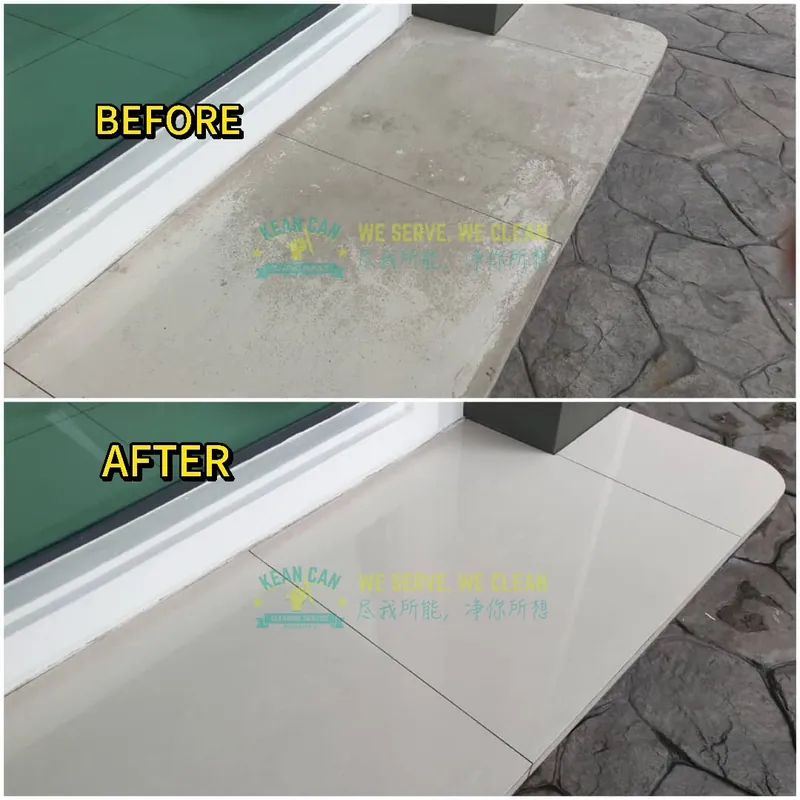
The black and green on a driveway, car porch or boundary wall is living growth rather than dirt: algae, moss, lichen and microbial film, on any outdoor surface that stays damp. Most of it washes off, because most of it is a layer the water can reach. How much is the question a test patch settles — growth that has sat in open, porous concrete for years can leave a shadow behind it — and because the damp that grew it is still there, it comes back.
The Brick Industry Association names the condition behind it: a masonry surface that "remains in a constantly damp condition, thus encouraging moss, algae, lichen, or other microbial or organic growth". Damp, not dirty, is the operative word, and it is why the worst patches sit in the shade, beside the drain and under the porch roof. This page is about those surfaces — driveways, car porches, outdoor pavers and exterior walls.
Colour is a poor guide to what you have. Researchers inspecting colonised brick paving at the University of Venda, South Africa, recorded "a green colouration" during a rain period and that "After the rain period, the green colouration turned black" — the same growth read twice. Their authors offer two possible reasons, sunlight bleaching the algae "and/or" the algae being photosensitive. A driveway that looks green one month and black the next has not necessarily acquired a second problem.
Not every dark mark outside is growth, though, and the ones that are not behave differently under a wash:
- Engine oil and gearbox drips where the car sits: a degreasing job, not a pressure one, and an old spill soaked into open concrete may never fully lift.
- Tyre rubber and scuff marks at a driveway's turning point — mechanical marks rather than a film, answered by scrubbing rather than more pressure.
- Rust bleeding from a gate, grille or railing, which returns from the metal above until that is dealt with.
- Leaf and bark tannin under a tree, usually browner than black-green, which often lifts with the growth around it.
Send a photograph of the worst patch and rough measurements to 014-313 0767 and we will tell you which of these it looks like — including when the answer is that cleaning is not what the surface needs.
02How hard can a driveway or wall be washed?
Harder is not better, and the ceiling belongs to the material rather than to the machine. The Brick Industry Association sets four pressure bands for cleaning brickwork and brick paving, and puts anything above 800 psi outside the range it considers appropriate for brick at all. Concrete, render, outdoor tile and painted walls each have their own ceiling.
| Band | Measured at the nozzle tip | What the note uses it for |
|---|---|---|
| Very low | Under 100 psi (700 kPa) | Pre-wetting, before anything else happens |
| Low | 100 to 400 psi (700 to 2,800 kPa) | Rinsing. 400 psi is the brick ceiling "unless permitted by brick manufacturer" |
| Medium | 400 to 800 psi (2,800 to 5,600 kPa) | "may be appropriate in some cases, with certain types of brick" — "Use only if permitted by the brick manufacturer" |
| High | Above 800 psi (5,600 kPa) | "not appropriate for brick and may damage the brickwork" |
There is no equivalent published figure for a concrete driveway or interlocking paver, and this page will not invent one: that number comes from the surface's manufacturer and from a test patch on the surface itself. It is why a quotation names a method rather than a pressure.
Delivery matters as much as the number: the note asks for a "25 to 50 deg. fan-shaped stainless steel nozzle tip" held at "a distance of 12 in. (305 mm) minimum" from the surface. A narrow jet held close carves the stripe into a driveway that no further washing will blend out. Excessive pressure, it warns, "may damage brick surfaces, erode mortar joints, and remove finishes or other surface coatings".
Indoors the same decision is made with pads and chemistry instead of water pressure: that is floor scrubbing versus polishing, inside our guide to tile, floor and grout restoration.
03Does an outdoor wash need a cleaning solution, or just water?
Water lifts the layer you can see. The masonry guidance does not stop there: for organic growth the Brick Industry Association points to biocides "targeted to remove organic and microbial growth on masonry surfaces", and for moss and lichen in paving joints it records that these "can be killed using bleach and water mixed in a ratio of one to one or proprietary biocide treatments". Killing growth and washing it off are two different steps.
Which of them a particular surface needs is settled at the test patch rather than in advance, and it is a decision with consequences either way. The same note caps the pressure a cleaning solution may be applied at: "No more than 50 psi (350 kPa) of pressure should be used, because higher pressure can force the cleaning solution deep into the masonry to become a source of future staining." Driving chemistry into a wall is how a cleaned wall stains later.
A painted or rendered wall is the clearest case for restraint. The warning that pressure can "remove finishes or other surface coatings" is exactly why a painted boundary wall is treated at lower pressure than an open concrete driveway — and why, where the paint has already failed, washing is not the job the wall needs at all.
04Why does it come back so quickly?
Because a wash removes the growth and changes nothing about the conditions that grew it. A shaded, slow-draining surface is still a shaded, slow-draining surface the day after it is cleaned. What the measurements show is how closely the growth tracks rainfall: it responds to the next rain, not to the calendar.
A 2023 study in PLoS One monitored an already-colonised wall and its paving daily and found that "the microorganism development rapidly responds to rainfall events", and that "peaks of green algae and cyanobacteria occur a few hours after a rain event". The same team used a tile that had previously been bleach-cleaned as a comparison, which let them trace the organisms reappearing on the paving after rain to "the remobilization of microorganisms present on the stones" rather than to contamination from the paving stones next to it. What comes back comes back from what is still on the surface.
So nobody can honestly sell you a date by which an outdoor surface will stay clean, and we do not. What lengthens the interval is drying the surface out: a gutter that stops overflowing, a planter moved off the paving. Fixing those is not cleaning work and is not on our quotation, but we will point them out when we see them.
05Three things a wash will not fix
Washing removes what sits on a surface. It does not repair the surface, and it does not stop water arriving at it. Three outdoor problems look like staining from a distance, and each of them needs something other than a cleaner with a machine before it is worth spending money on the area.
- Damage already in the material. Etching and lost surface finish are damage to the material, not soil sitting on it — and an earlier wash can be the cause, since the BIA warns that excessive pressure "may damage brick surfaces, erode mortar joints, and remove finishes or other surface coatings". A test patch separates a dirty surface from a damaged one.
- Salt bloom pushed out from inside. Chalky white bloom on a boundary wall is not on the wall, it is coming through it, so cleaning it is pointless until the water is dealt with. The BIA's instruction for recurring efflorescence is to "identify and correct the source of water penetration and allow the brickwork to dry" first, and on a new building to allow "one year of weathering to naturally remove new-building bloom". The same logic indoors is mould after a leak: what cleaning fixes and what it does not.
- Paint or render that has failed. Water takes off what has already let go and will not re-bond the rest, so a wall with flaking paint comes out of a wash looking honest rather than new. Putting the paint back is not cleaning work, and we would rather say so at the quotation.
06Driveway, car porch and exterior wall washing in Ipoh and Perak
Kean Can Cleaning Service pressure washes driveways, porches, outdoor pavers and exterior walls across Ipoh and Perak, where the surface will take it. The work is scoped with a test patch, cleaned by the team and read once it has dried, which settles the two questions that decide the job: how much of the black and green will genuinely lift, and what pressure this surface takes without being marked.
That is the industry's own discipline, not a house rule: the BIA holds that "It is always best to test a small area before subjecting the entire project to the cleaning procedure", with the trial judged after it has dried. Photographs are a good first step and will usually tell us what you are dealing with, but like the rest of our floor work an outdoor wash is quoted after a site visit rather than from photographs alone.
Paved areas get one extra check, because the joints are the fragile part. Writing about brick paving, the Brick Industry Association records that "Aggressive pressure washing can cause localized removal of joint sand", and that stabilised sand-filled joints "are generally resistant to pressure washing if the nozzles are kept clear of the surface and the water jet is not aimed directly along the joints" — two conditions that depend on how the jet is held rather than on how hard it is set.
What this service covers is on the tile and floor cleaning service page. To have an area looked at, send photographs and rough measurements to 014-313 0767.
07What else people ask
Will the run-off damage my plants or flood the garden?
It can, so say where things are before anyone starts. The Brick Industry Association warns that "Cleaning chemicals may also damage plants and grass", and says "It may be necessary to prevent the cleaning solution and runoff from contacting plants or the surrounding soil". Volume is the other half: it puts pressurised water cleaning at "4 to 6 gal per minute (15 to 23 L per minute)", so a large driveway sends a lot of water downhill.
Can I do it myself with a home pressure washer?
On a small, sound concrete apron, a domestic machine and some patience will get a real result. The two things that go wrong are hard to reverse: a narrow jet held close marks the surface in lines, and washing along paver joints takes the sand out. Walls above head height and anything painted are where the risk outweighs it.
What should I do before the team arrives?
Clear the area: move the cars out, lift pots and furniture, and say where the drains, the beds and the neighbour's boundary are. How long an area takes depends on its size and surface, and comes with the quotation after the site visit rather than as a number on a web page.
Is this the same work as the floor scrubbing you do indoors?
Same team, different method. An indoor floor is machine-scrubbed with the pad and chemistry chosen for that material, because the soil is grease, traffic marks and cement film. Outdoors the surface is open, the soil is biological, and the method is chosen around what the surface will take. Kean Can Cleaning Service does both, across Ipoh and Perak.
08Where this comes from
Three documents carry the factual claims on this page. A masonry cleaning standard supplies the pressure bands, the nozzle rules and the instructions on organic growth, efflorescence and joint sand. A 2023 journal study supplies the measured link between rainfall and regrowth. A 2019 journal paper supplies the colour observation and the slip hazard.
- Brick Industry Association, Technical Notes on Brick Construction 20: Cleaning Brickwork (August 2018) — pressure bands, nozzle and standoff, the damage warning, organic growth and biocides, the 50 psi limit on applying a solution, joint-sand loss, the test-area rule, efflorescence, run-off.
- Reboah, Balland Bolou-Bi, Nowak and Verney-Carron, "Influence of climatic factors on cyanobacteria and green algae development on building surface", PLoS One 18(3): e0282140 (2023) — the response to rainfall, and the bleach-cleaned comparison tile.
- Munyai, Sonqishe and Gumbo, "Algae colonisation of brick pavement at the University of Venda: A potential slippery hazard", Jàmbá: Journal of Disaster Risk Studies 11(2): a689 (2019) — the green-to-black observation and the slip hazard.
None of the three is a Malaysian standard, and each is quoted for one thing. The BIA note covers brickwork and brick paving, so its figures show that a ceiling exists and how it is set, not what to use on concrete, render or outdoor tile. The PLoS One study monitored an already-colonised wall in the temperate Paris region against rainfall — not regrowth after a professional clean — so the mechanism carries here and its seasons do not. The Venda paper is a single site in Limpopo, South Africa, and its green-to-black explanation is offered as probable rather than settled.
Written by the Kean Can Cleaning Service crew in Ipoh, Perak — about the company.
Ask about your property
Send a photograph and tell us the scope so the team can assess the work.
Ipoh and across Perak.