
Cleaning advice · 07 Oct 2026
How often should an office or showroom be cleaned?
There is no single correct frequency, but for most offices the starting point is daily. Malaysia’s Industry Code of Practice on Indoor Air Quality 2010 ties the cleaning schedule to occupancy patterns and activity levels, and calls daily surface cleaning and steam vacuuming advisable for high-traffic areas, naming most office areas among them. Showrooms sit with them. The jobs that disturb the air are a separate periodic appointment.
01How often should an office be professionally cleaned?
For most offices, daily. Malaysia's Department of Occupational Safety and Health calls it advisable in its Industry Code of Practice on Indoor Air Quality 2010, approved by the Minister on 30 August 2010. Its housekeeping clause says that "Daily cleaning of surfaces and steam vacuuming of floors is advisable for areas with high traffic or which are in constant use during the day", and adds that "These include most office areas and public places."
That is the starting point, not a fixed rule. The same clause opens by saying the schedule "shall be arranged with reference to occupancy patterns and activity levels". So the honest answer to how often is a question back: how many people use the space, and what do they do in it. A six-desk office that empties at five is not the same job as a showroom with walk-in traffic all weekend.
That is also why this site says elsewhere that frequency follows traffic and surface rather than the calendar, and the two are the same answer: the code's daily advice is the default for the light round in a space in constant use, and the schedule that is actually quoted still comes from how the space is used and what its floors are made of. The commercial guide takes the same position in its own chapter on frequency, why the calendar is the wrong tool.
The code applies to buildings served by a mechanical ventilating and air conditioning system, including air-cooled split units, where there are people at work, and it excludes domestic buildings and areas used for domestic or industrial purposes. That is most Malaysian offices and most showrooms, and it is not a factory or warehouse floor: the code counts storing and warehousing as industrial purposes. It is written for building owners, building management and employers, which means the schedule is their decision to make and the cleaner's to carry out.
02Why does cleaning frequency affect office air quality?
Because dust that is not removed becomes something the air carries. The code puts it plainly: "Housekeeping is important in preventing indoor air quality problems as it keeps dust levels down and removes dirt which could otherwise become sources of contamination."
That reframes what a cleaning schedule is for. It is not only about how a reception area looks to a visitor. Dirt left on floors, sills and surfaces is a reservoir, and foot traffic and air movement put it back into the room. A schedule set for appearance alone will under-clean the places nobody looks at.
The code's own walkthrough checklist asks two questions that make the same point from the other direction. One is "Is the building adequately cleaned?" The other is "Are the carpets vacuum-cleaned regularly?" Both sit in an air-quality inspection, not a housekeeping audit.
03Is a showroom different from an office?
By the code's own test, yes, and usually in the direction of more frequent cleaning. The schedule follows occupancy patterns and activity levels. A showroom carries public foot traffic, often across long opening hours and weekends, so on that test it sits with the high-traffic areas for which the code calls daily cleaning advisable.
What changes for a showroom is the finish, not the frequency. Display floors, glass and stock surfaces are the product as much as the premises, so the work is as much about keeping a finish presentable as about removing soil. Kean Can Cleaning Service lists car-showroom polish and upkeep as its own service line, separately from scheduled office cleaning.
| Space | Light round | Periodic appointment |
|---|---|---|
| Reception and public floor | Daily while open | Floor finish, glass at height |
| Open-plan desks | Daily in constant use, less if lightly occupied | Carpet deep clean |
| Washrooms and touchpoints | Daily, more than once where traffic is heavy | Deep descale, grout |
| Pantry and kitchen | Daily after use | Degrease, appliance interiors |
| Showroom display floor | Daily while open, including weekends | Polish or burnish to the finish |
| Glass and windows | Spot clean on the light round | Full clean, access equipment where needed |
Washrooms are the part of the table that moves most. The code's test is occupancy and activity, and a washroom in a busy office meets both harder than the desks do, which is why it is the one space where a single daily visit is often not the answer. Glass is the opposite case: it is traffic marks on the light round, and a full clean on its own interval.
The practical consequence is that a showroom quote usually needs two frequencies in it. A daily or near-daily light clean for the public areas, and a periodic appointment for the floor work. Which periodic jobs those are is the subject of the next section.
04Which cleaning jobs cannot simply be added to the daily round?
The ones the code calls prescribed activities. It defines these as "any activity that could pose health hazard to the occupants", and its list includes cleaning carpets, applying floor finishing and stripping products, and applying or removing floor coverings including carpeting and floor tiles. Painting, wall coverings, pest control products and sealing compounds are on the same list.
Those jobs come with controls attached, and one of them is timing. The code requires adequate work procedures and control during prescribed activities, and lists six measures. Among them are approved personal protective equipment, warning signage, a portable exhaust system and "administrative control measures such as carry out prescribed activities not during working hours."
So a carpet clean or a floor strip and reseal is not a bigger version of the daily round. It is a separate appointment, planned around when the building is empty, with the area marked off while it is done. Tile and floor restoration is the pillar on what that work involves, and scrubbing against polishing covers which of the two a dull floor actually needs.
05How often should office air-conditioning be cleaned?
At least every six months for most of it, and at least monthly for the water trays. The air-conditioning runs on its own clock, separate from the cleaning round, and the code states the minimum intervals. Where the manufacturer has not specified a frequency, the code's own figures become the minimum. Air-handling unit components such as fans and dampers are to be cleaned at least every six months, and the code adds "depending on the condition of the incoming air and use of the system". Cooling coils and condensate pipes are also at least every six months, and water trays at least every one month.
Filters are the exception that is not on a calendar at all. The code says filters "shall be cleaned or replaced so that they are performing properly at all times and do not become clogged", which is a condition test rather than an interval. The system itself is to be inspected at least every six months, and checked and adjusted after the first year and at least every two years after that.
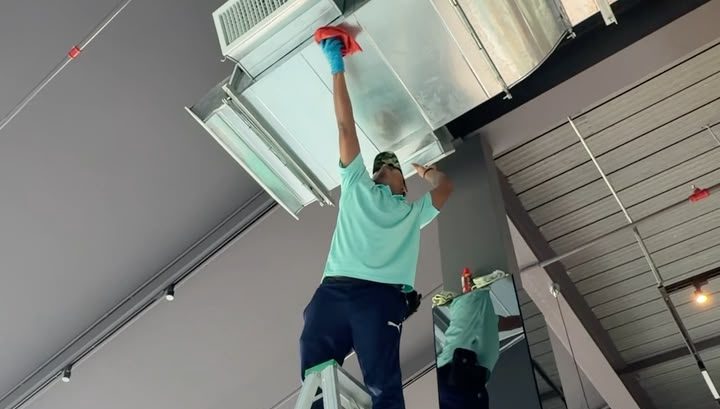
This matters for an office manager comparing quotes, because the line falls inside the plant. A cleaner reaches duct exteriors, grilles, louvres, ledges and facade glass. The coils, condensate pipes, water trays and filters inside the system belong to a mechanical ventilating and air conditioning maintenance contract, which is a different contract from a cleaning schedule. Confusing them is how a building ends up with spotless desks and a clogged filter.
06What should you put in the brief when you ask for a quote?
Six things make an office or showroom cleaning quote comparable between contractors. They are, in the order a contractor needs them:
- Floor area and layout, including how much is public-facing and how much is back of house.
- Occupancy pattern and hours, because the code ties the schedule to exactly this. Say whether the space runs weekends.
- Floor and surface types. Carpet, tile, vinyl, marble and glass are different jobs on different cycles.
- The light round frequency you want, and whether it is before opening, after closing or during the day.
- The periodic jobs: carpet cleaning, floor scrubbing or polishing, high-access glass, and roughly how often.
- When the building is empty, since the code's own control for prescribed activities includes doing them outside working hours.
Kean Can Cleaning Service, registered in 2019, is run by Chu Wai Kean with his daughter Chloey and works across Ipoh and Perak. Scheduled office cleaning, car-showroom polish and upkeep, clinic and hospital-grade disinfection cleaning and factory and warehouse floor scrubbing are all on its commercial list, and the company counts 50 or more long-term commercial accounts. On Facebook, 92 per cent recommend it, from 9 reviews.
Related reading: what the commercial service covers in Ipoh, and a contractor against an in-house cleaner if the two schedules make you ask who should run them.
Send those six lines through the contact page, call 014-313 0767 or message the same number on WhatsApp. Scope, timing and a price range come back the same way. Floor restoration, height work and vacant property are quoted after a site visit rather than from photographs alone.
07Questions people ask about office and showroom cleaning frequency
Is cleaning an office once a week enough?
Not for a space in constant use during the day. Malaysia's Industry Code of Practice on Indoor Air Quality 2010 calls daily surface cleaning and steam vacuuming advisable for high-traffic areas, and names most office areas among them. A weekly visit may suit a small, lightly occupied office, but the argument for it has to be occupancy and activity.
How often should office carpets be cleaned?
The code does not set an interval for carpets, and nor will an honest contractor without seeing them. What it does ask, in its own walkthrough checklist, is whether the carpets are vacuum-cleaned regularly, and it classes cleaning carpets as a prescribed activity with controls attached. So the vacuuming belongs in the frequent round, and the deep clean is a separate, planned appointment.
Should office cleaning be done after hours?
For the jobs the code calls prescribed activities, after hours is one of its listed controls. Its wording is "administrative control measures such as carry out prescribed activities not during working hours." For the ordinary daily round the code sets no such requirement, so before opening, after closing or during the day is a practical choice rather than a compliance one.
Why does a showroom floor look worse than an office floor on the same schedule?
Because of the lighting, not the dirt. Display spotlights rake across a polished floor and show every swirl mark and traffic lane that overhead office lighting hides, so the same standard of clean reads as a worse result. On an unfamiliar floor the cleaning team takes a test patch in a corner before anything is done at scale. What scrubbing and polishing each do is set out separately.
Who is responsible for setting the cleaning schedule?
The code addresses its housekeeping and maintenance duties to the building owner, the building management or the employer. A cleaning contractor carries out the schedule and advises on it. The decision on frequency, and the record of what was done, sits with whoever occupies or manages the building.
More guides on commercial and post-renovation cleaning are collected in our insights.
Sources. Department of Occupational Safety and Health, Ministry of Human Resources, Malaysia, Industry Code of Practice on Indoor Air Quality 2010, read 7 October 2026 from the copy published by the University of Malaya's occupational safety and health resources library. Quoted and summarised here for: its approval by the Minister on 30 August 2010; its application to buildings served by a mechanical ventilating and air conditioning system including air-cooled split units where there are people at work; clause 3.7 on housekeeping and cleaning, including the schedule being arranged with reference to occupancy patterns and activity levels and the daily cleaning advice for high-traffic areas; its definition of prescribed activities and the examples of cleaning carpets, applying floor finishing and stripping products and applying or removing floor coverings; clause 3.4 and its six controls for prescribed activities, including signage and carrying them out outside working hours; clause 3.3 on inspection and maintenance of the mechanical ventilating and air conditioning system, including the six-monthly and monthly intervals and the condition requirement for filters; and the walkthrough checklist questions on whether the building is adequately cleaned and whether carpets are vacuum-cleaned regularly. Quoted phrases are marked; nothing else is reproduced from the code, and none of its tables or limit values appears here. The code is guidance from a Malaysian government department and is cited because it is the Malaysian reference on this question. It is not a certification, an endorsement or a compliance claim by or about Kean Can Cleaning Service. For what the code requires of a particular building, read the code itself and take advice. The service list, service area, test-patch practice and quoting practice above are Kean Can Cleaning Service's own, from the pages linked.
Ask about your property
Send a photograph and tell us the scope so the team can assess the work.