
Cleaning advice · 07 Nov 2026
Cleaning high windows safely: pole, ladder or lift
High windows are cleaned safely by choosing the method in order: avoid working at height if possible, by cleaning from the inside or with a water-fed pole from the ground. If not, work from a place that is already safe, such as a balcony. Only then use access equipment, with fall arrest where a fall is still possible.
On this page10 sections
This guide is for homeowners, shop owners and building managers in Ipoh and elsewhere in Perak with windows or glass that cannot be reached from the floor: double-height living rooms, shopfronts, stairwell glazing and upper-floor exteriors. The safety order comes from the UK's Health and Safety Executive (HSE), the regulator for workplace safety there, and from water-fed pole guidance written by the Federation of Window Cleaners. This page follows that UK practice; it is not a statement of Malaysian rules, which a building owner should check for their own site.
01How are high and exterior windows cleaned safely?
The HSE sets four steps for window cleaning businesses, and each one is used only when the step above it is not reasonably practicable: clean without working at height, then from a place that is already safe, then with suitable access equipment, and last with fall arrest to limit a fall. Most of a safe job is decided before anyone climbs.
The HSE's page on working at height whilst window cleaning sets this order out for window cleaning businesses. You must avoid work at height where it is reasonably practicable to do so
, for example by using telescopic water fed poles or cleaning windows from the inside
.
- Avoid height: clean from inside, or from the ground with a water-fed pole.
- Use an existing safe place: cleaning from inside windows or from a balcony.
- Provide suitable access equipment where no safe place exists.
- Where the risk of falling is still there, use fall arrest equipment to cut the distance and consequences of a fall.
The HSE adds that it is important to discuss the work with the client, the person who asked for the work,, who will know whether the window design allows safe cleaning from the inside.
02Can I clean high windows myself, or should I hire a cleaner?
Clean what you can reach from inside or from the ground yourself. A ladder is only for a low-risk, short job on firm, level ground, kept stable and, whenever possible, tied. Glass that needs a powered lift, a roof, a harness or the area below closed off is work for people trained and equipped for height, with a plan for each of those.
The HSE's guidance is written for window cleaning businesses, and it says that All those working at height must have the right skills, knowledge and experience.
A cleaner working on high glass needs different skills from someone only involved in cleaning ground floor windows
.
Whoever does the work, the same questions apply. Before booking, ask the cleaner which method they will use and why, how the area below will be kept clear, what happens if the weather turns, and how tools are kept from being dropped.
03What is a water-fed pole, and how high can it reach?
A water-fed pole is a telescopic pole with a brush at the top and a supply of purified water. The cleaner stays on the ground and scrubs and rinses the glass from below, and the Federation of Window Cleaners says these systems clean windows up to 80 ft, about 24 metres, high from ground level.
The Federation's guidance on safety in window cleaning using water-fed pole systems, published on the HSE website, defines the pole as a telescopic pole fitted with a brush and a means of delivering purified water for window cleaning
, and says the purified water is an integral part of the cleaning process. It also says the pole removes the need to work at height
, provided the window can be seen from the ground without obstruction.
Why purified water? The Federation calls it an integral part of the cleaning process
, and the Wikipedia entry on window cleaners explains that because no solids are dissolved in it, the windows dry clear without water spots
. The brush loosens the dirt while water sprays, then the cleaner lifts it slightly and rinses the glass.
The guidance also warns against overreaching with a longer pole than the job needs: do not use a 45ft pole to clean a window which is 20ft high
. The lightest pole that reaches the top of the window is the right one.
04When is a ladder the right choice?
A ladder is the right choice for low-risk, short jobs, as long as it is strong, long enough, free of defects and kept stable. The HSE says a ladder should not be the automatic choice, and that most ladder falls happen because the ladder moves, so it is kept stable and, whenever possible, tied to a suitable point.
On ladders, the HSE's page says that Almost all falls from ladders happen because the ladder moves unexpectedly.
The key to preventing a fall is keeping the ladder stable while it is used, by looking carefully at the working conditions and, whenever possible, tying it to a suitable point.
Before a ladder goes up, check what it stands on. The HSE asks whether the ground is sloping, muddy or uneven
, and whether the surface is strong enough to take the weight of the workers and their equipment.
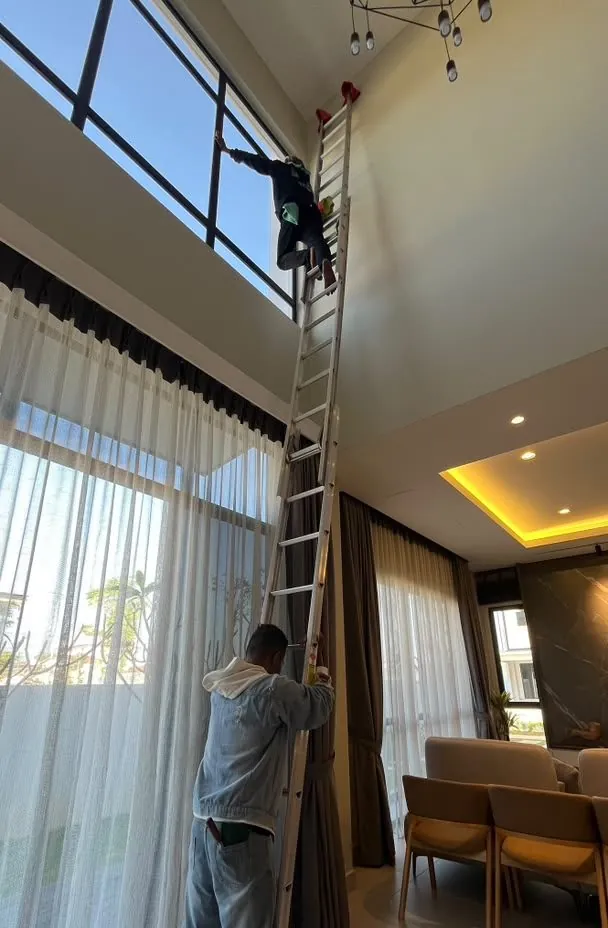
Glass inside a double-height room is more often a ladder job than an outside one, because a water-fed pole sprays water and suits outside glass. The same rules apply indoors: a stable ladder for a short task, tied whenever possible, and specialist access equipment where a ladder is not enough. The photograph at the top of this page shows that kind of job.
05What about glass a pole or ladder cannot reach?
Glass that a pole from the ground or a ladder cannot reach needs specialist access equipment, such as a mobile elevating work platform (a powered lift), a cradle or rope access, chosen by height, site conditions, how long the work takes and how often it is needed.
The HSE says the choice of access equipment for every job will be determined by the height to be negotiated, site conditions, duration and extent of work and frequency of access
, and that this equipment must be properly maintained and regularly inspected. Planning a whole facade, and what a lift does to the cost, is covered in the guide to glass and high-access cleaning.
Where a fall is still possible, the HSE describes fall arrest as normally a safety harness suitable for fall arrest, connected via an energy-absorbing lanyard, to a suitable anchor point
. It also says to consider measures that protect everyone at risk before measures that protect only one person. The Federation's guidance notes that a water-fed pole up to 3 metres long can also be used from a powered lift, secured to the basket so it does not fall if dropped.
06When should high window cleaning stop?
A water-fed pole is not used in high winds, during thunder and lightning or near overhead power lines, and the HSE asks for procedures to stop work in adverse weather that could endanger people working at height. On a busy street, keeping the public out of the area directly below is part of the plan.
The Federation's list of don'ts is plain: Don't use a water-fed pole in high winds.
Don't use a water-fed pole near to overhead power lines.
Don't use a water-fed pole during thunder and lightning.
It adds that although purified water has low conductivity, water-fed pole systems must be treated as potentially conductive in real working conditions
.
For buildings on busy streets, the HSE asks the cleaner to think about the time of cleaning, the traffic and preventing public access to areas directly below the working area
, so nobody is struck by a falling object.
07What should an owner check before high windows are cleaned?
Before high windows are cleaned, an owner should know how the glass will be reached, what is overhead and underneath, and who closes the area below. The HSE lists height, access, location, weather, the surface and ground, and how tools are kept from falling as the conditions to look at.
| Check | The question to ask |
|---|---|
| Height | How high is the job from the ground? |
| Access | How do the cleaners get to and from the glass, past fragile surfaces, obstructions and power lines? |
| Location | Is there traffic or public access below that needs closing off? |
| Weather | Is there a plan to stop in high winds or bad weather? |
| Surface and ground | Is it strong, level and stable enough for the equipment? |
| Tools | How do tools go up and down, and how are they kept from being dropped? |
Agreeing these points before the day means the cleaner arrives with the right equipment for the glass, and nobody has to decide how to reach it while standing under it.
08What should you send when asking for high glass to be cleaned?
Send the building type, how many floors, a rough count of windows or glass panels, photos taken safely from the ground or from inside, and what is around and below the glass, so the site visit and the quote start from the right facts.
Kean Can Cleaning Service, cleaning in Ipoh and across Perak since 2019, does interior and exterior glass, including high-access work; its glass and window cleaning service covers interior and exterior panes, shopfronts, showroom facades and windows too high to reach from a ladder. For height work the company asks for a site visit before anything is confirmed, and its equipment and chemicals are its own and sit inside the quote.
- The building: house, shop, office or block, and how many floors.
- Roughly how many windows or panels, and whether inside, outside or both.
- Photos of the glass, taken safely from the ground or from inside.
- What is around it: a balcony, a porch roof, cables or a busy walkway below.
- When the building is in use, so the work can be timed around it.
WhatsApp 014-313 0767, or browse the other cleaning guides.
09What else do people ask about cleaning high windows?
Four short answers to the questions that follow. The outside facts come from the HSE and the Federation of Window Cleaners.
Is a water-fed pole safer than a ladder?
For the risk of falling, yes: the cleaner stays on the ground, which is why the HSE names water-fed poles as a way to avoid work at height. A pole has its own risks, such as power lines overhead and the weight of a long pole, so the lightest pole that reaches the top of the window is used.
Can windows on the upper floors be cleaned from the inside?
It depends on the window design. The HSE says the client will know whether the window design allows safe cleaning from the inside, which removes the risk of falling.
Why do windows cleaned with a pole dry without spots?
Because the water is purified. Wikipedia's entry on window cleaners explains that with no solids dissolved in the water, the windows dry clear without water spots.
How is a high window cleaning job quoted?
Send the building type, floors, a rough window count and photos (taken safely from the ground or inside) on WhatsApp. High-access cleaning is height work, so Kean Can Cleaning Service asks for a site visit before anything is confirmed; its equipment and chemicals are its own and sit inside the quote.
10Where does this information come from?
The safety order and checks come from UK guidance, written for window cleaning businesses there; the checklist of what to send is the company's own practical advice. Sources read on 7 November 2026.
- HSE, "Working at height whilst window cleaning": the order of methods, ladders, access equipment, fall arrest and the site checks.
- Federation of Window Cleaners, "Safety in window cleaning using water-fed pole systems" (on the HSE website, amended 31 March 2026): what a water-fed pole is, its reach, pole length, the don'ts and overhead power lines.
- Wikipedia, "Window cleaner": why purified water dries without spots.
This page is general guidance, not legal advice. Follow the rules that apply to your building in Malaysia.
Written by the Kean Can Cleaning Service crew in Ipoh, Perak: about the company.
Ask about your property
Send a photograph and tell us the scope so the team can assess the work.
Ipoh and across Perak.